

Imagine a spacecraft hurtling back to Earth, blazing through the atmosphere at hypersonic speeds. The friction generates unimaginable heat, turning the surrounding air into a superheated plasma that could melt conventional materials in an instant. This is the daunting challenge facing SpaceX’s Starship, an ambitious endeavor for fully reusable space travel. To conquer this inferno, Starship V3 is set to incorporate a marvel of material science: graphene-enhanced thermal protection system (TPS) tiles. But what’s the secret sauce? The answer lies deep in the chemistry of graphene and its unparalleled thermal conductivity.
The Fiery Gauntlet: Re-entry Heat
Atmospheric re-entry is perhaps the most brutal phase of any space mission. Temperatures on the leading edges of a spacecraft can soar to upwards of 1600-2000°C. Traditional solutions have included ablative materials, which burn away to carry heat with them, or ceramic tiles, which insulate by absorbing and slowly radiating heat. For Starship, which aims for rapid, frequent reusability, these solutions need an upgrade. Durability, lightweight design, and superior heat dissipation are paramount.
Graphene: The Thermal Superconductor
Enter graphene, a revolutionary material that’s been lauded for its extraordinary properties. Discovered in 2004, this two-dimensional wonder is a single layer of carbon atoms arranged in a hexagonal, honeycomb lattice. It’s the thinnest, strongest, and most conductive material known to humankind.
What is Graphene?
At its core, graphene is pure carbon, but its atomic arrangement gives it superpowers. Imagine a chicken wire fence, but made of individual carbon atoms. This perfect, defect-free structure is the key to its incredible capabilities. While diamond is a great insulator, graphene, despite also being carbon, is an exceptional conductor.

How Graphene Conducts Heat
Heat transfer in materials primarily occurs through two mechanisms: electron movement (common in metals) and phonon movement (vibrational energy in the atomic lattice). In graphene, phonons are the superstars. Its perfectly ordered 2D lattice allows phonons to travel with minimal scattering, leading to exceptionally high thermal conductivity – reported to be as high as 5000 W/mK at room temperature, dwarfing copper’s ~400 W/mK. This means graphene can rapidly spread heat across its surface and through its structure, preventing localized hotspots and efficiently dissipating thermal energy.
Graphene in Starship V3 Tiles: The Chemistry of Integration
It’s important to note that Starship V3 tiles aren’t made of pure graphene. Instead, graphene is incorporated into a ceramic matrix, forming a graphene-enhanced composite. This marries the structural integrity and high-temperature resistance of ceramics with graphene’s phenomenal heat dissipation capabilities.
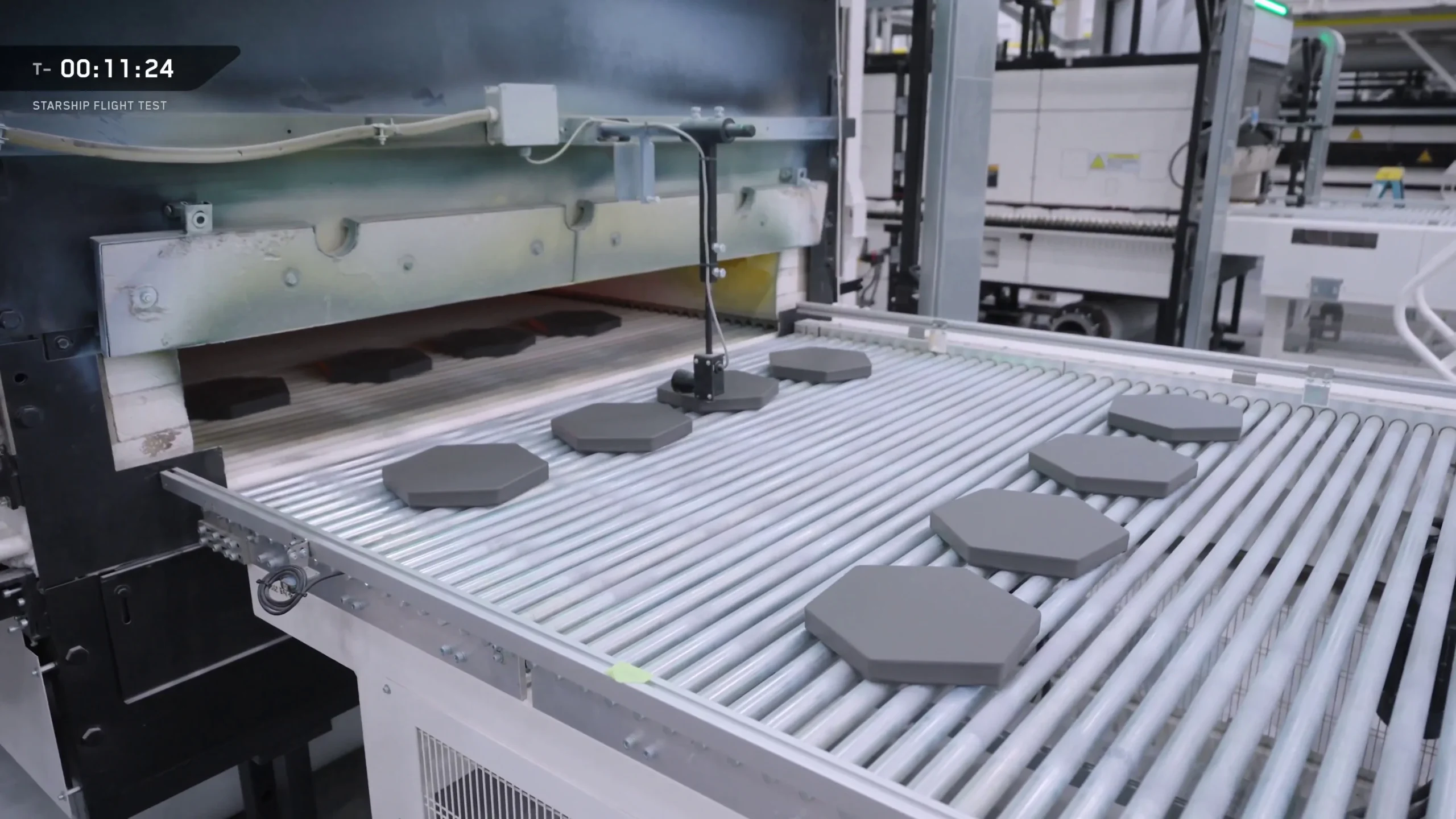
Beyond Pure Graphene: Composites for Strength and Performance
The challenge isn’t just about having graphene, but how it integrates with the existing ceramic tile material. The goal is to create a robust composite that leverages graphene’s conductivity without compromising the ceramic’s structural strength at extreme temperatures. This involves meticulous engineering at the molecular level to ensure strong interfacial bonding between the graphene flakes/sheets and the ceramic matrix.
Interfacial Bonding & Enhanced Phonon Transport
The chemistry here is crucial. For heat to efficiently move from the hot ceramic material into the graphene network, and then be rapidly transported away, there must be excellent chemical or mechanical adhesion (interfacial bonding) between the two components. Poor bonding would create thermal resistance, negating graphene’s benefits. With strong bonding, phonons can smoothly transition from the ceramic lattice into graphene’s superhighway, allowing the composite tile to:
- Dissipate heat more quickly and uniformly.
- Reduce thermal gradients, minimizing internal stresses and improving durability.
- Potentially reduce the overall weight of the TPS due to improved efficiency.
Key Takeaways
- Starship V3 tiles utilize graphene to significantly enhance thermal conductivity.
- Atmospheric re-entry poses extreme heat challenges, requiring advanced material solutions.
- Graphene, a 2D carbon material, conducts heat exceptionally well via phonons due to its perfect atomic lattice.
- It’s used in composite form, integrated into a ceramic matrix for structural integrity and thermal management.
- Strong interfacial bonding between graphene and the ceramic is critical for efficient heat transfer.
- This innovation promises lighter, more durable, and more efficient thermal protection for Starship.
- It exemplifies how cutting-edge material science is enabling the future of fully reusable spaceflight.
Conclusion
The integration of graphene into Starship V3’s thermal protection tiles is a testament to the power of material science and chemical engineering. By understanding and harnessing the unique properties of this atomic-scale wonder, SpaceX aims to overcome one of the greatest hurdles of reusable spaceflight: managing extreme heat. This innovation isn’t just about faster heat dissipation; it’s about enabling a future where space travel is more frequent, affordable, and sustainable. As Starship continues its journey towards orbit and beyond, its graphene-enhanced shield will be a silent, yet powerful, guardian against the fiery embrace of Earth’s atmosphere.
FAQ
What is Starship V3?
Starship V3 refers to the latest iteration or design modifications of SpaceX’s fully reusable, super heavy-lift launch vehicle and spacecraft system, designed for missions to Earth orbit, the Moon, Mars, and beyond.
Why is thermal conductivity so important for Starship’s tiles?
During atmospheric re-entry, Starship experiences extreme temperatures (up to 2000°C). High thermal conductivity in its tiles allows heat to be rapidly spread out and dissipated, preventing localized hotspots, reducing thermal stress, and protecting the vehicle’s underlying structure, crucial for rapid reusability.
How does graphene conduct heat so efficiently?
Graphene’s exceptional heat conductivity is primarily due to its perfect, two-dimensional hexagonal lattice of carbon atoms. This structure allows phonons (quantized vibrations that carry heat) to travel with very little scattering or resistance, enabling extremely rapid and efficient thermal energy transfer.
Are Starship V3 tiles made purely of graphene?
No, Starship V3 tiles are not pure graphene. Graphene is incorporated as a component within a ceramic matrix, forming a composite material. This allows the tiles to leverage graphene’s superior thermal conductivity while maintaining the structural integrity and high-temperature resistance of the ceramic base material.
What are the main benefits of using graphene in Starship’s thermal protection tiles?
The primary benefits include significantly enhanced heat dissipation, which reduces thermal stress and prevents damage; potentially lighter tile designs due to improved efficiency; and increased durability, contributing to Starship’s goal of rapid and frequent reusability. It also helps manage thermal gradients across the tile surface more effectively.
Could graphene be used in other aerospace applications?
Absolutely. Beyond thermal management, graphene’s unique properties make it suitable for various aerospace applications, including lightweight structural components, advanced sensors, EMI shielding, anti-icing coatings, and even as a component in next-generation batteries or supercapacitors for power systems.