
When we look back at humanity’s journey into space, few vehicles inspire as much awe as NASA’s mighty Saturn V. A towering behemoth that launched the Apollo missions to the Moon, its power was unmatched for decades. Yet, as we stand on the cusp of a new era of space exploration with SpaceX’s Starship, we realize that the challenges of going to space have evolved. One critical area where Starship faces a fundamentally different, and arguably more complex, engineering problem than its venerable predecessor is in its heat shield – a problem born from the very ambition of full reusability.
The Expendable Era: Saturn V’s Approach
The Saturn V was a marvel of its time, designed with one primary goal: to deliver a payload (the Apollo spacecraft) to the Moon. Every single stage of the rocket, except for the small Apollo Command Module, was expendable. The first stage fell into the Atlantic, the second into the Pacific, and the third either burned up in Earth’s atmosphere or was sent into a solar orbit. Only the Command Module, housing the astronauts, returned to Earth, protected by a robust but single-use ablative heat shield that sacrificed itself by burning away to dissipate the extreme heat of re-entry.
The core concept was simple: use it once, discard it. This design philosophy meant that the main rocket stages themselves never needed to endure the searing temperatures of atmospheric re-entry for subsequent use. Their fate was a fiery demise or a watery grave, not a careful return for refurbishment.

Starship’s Ambitious Goal: Full Reusability
Fast forward to Starship, and the paradigm shifts entirely. SpaceX’s vision for Starship and its Super Heavy booster is full, rapid, and low-cost reusability. Both the booster and the Starship upper stage are designed to return to Earth, land precisely, and be refueled and relaunched within hours or days. This ambition unlocks unprecedented potential for Mars colonization, lunar bases, and affordable satellite deployment.
However, this vision introduces an immense engineering hurdle: protecting the entire vehicle – a massive stainless steel structure – from the extreme temperatures generated during hypersonic re-entry. Unlike the small Apollo capsule, Starship is gargantuan, and its reusability demands a heat shield that can withstand repeated cycles of intense heating and cooling without significant degradation.
The Heat Shield Challenge: From Ablative to Ceramic Tiles
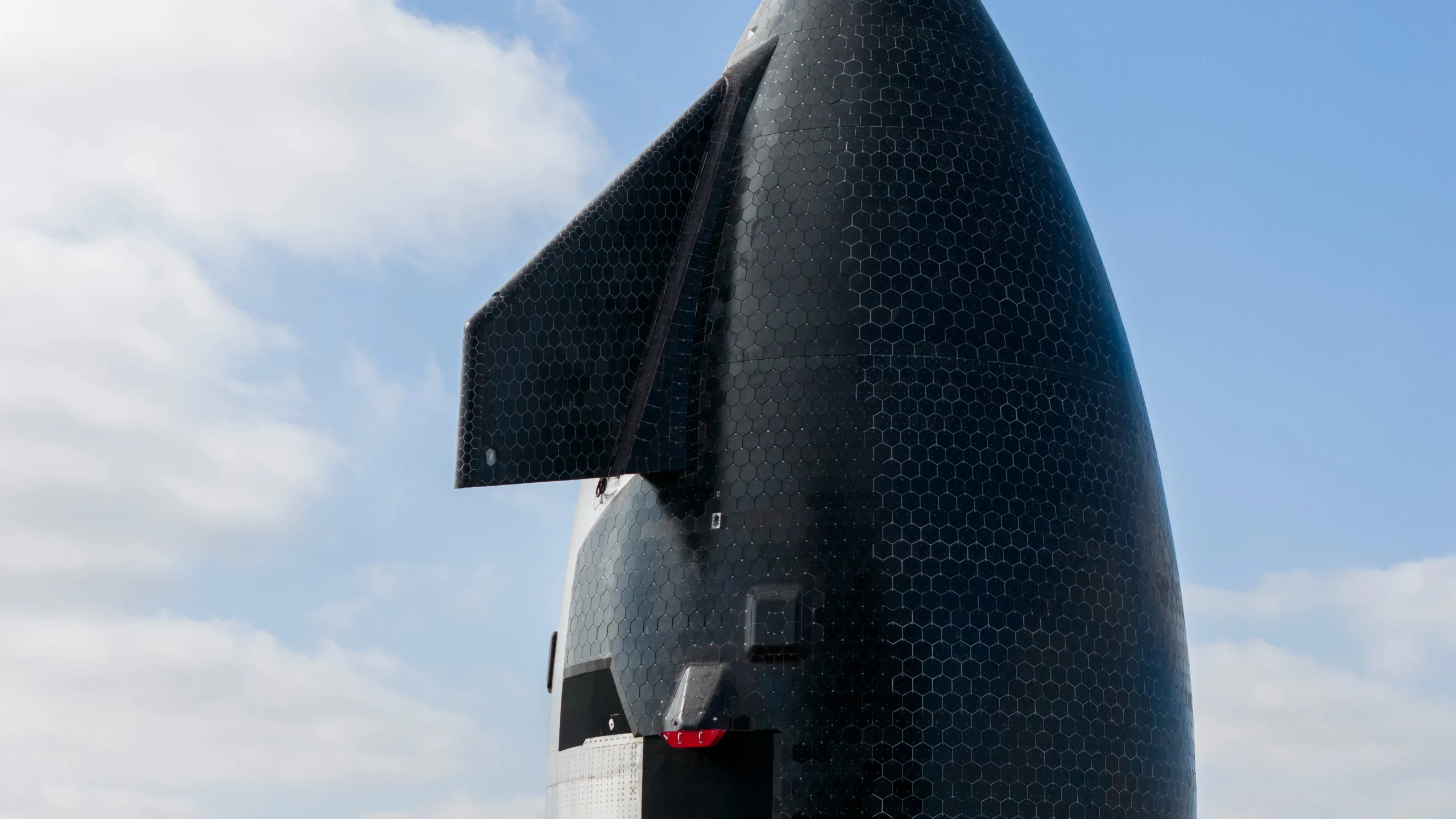
This is the problem Saturn V never faced. Saturn V’s stages didn’t need to survive re-entry intact and functional. Starship absolutely does. The solution comes in the form of thousands of specialized hexagonal ceramic tiles covering the entirety of Starship’s leeward side (the side facing away from the direction of travel during re-entry, but still experiencing significant heating).

A New Breed of Thermal Protection System (TPS)
- Material Innovation: Unlike the Space Shuttle’s silica tiles, Starship’s tiles are made from a novel ceramic material designed to be lightweight, highly insulating, and durable under extreme thermal cycling.
- Attachment and Scalability: The sheer scale of Starship requires an efficient and robust attachment mechanism for tens of thousands of individual tiles, each critical to the vehicle’s survival.
- Rapid Turnaround: Crucially, these tiles must be easily inspectable, maintainable, and replaceable to enable the rapid reuse that is central to Starship’s economic model.
Why Starship’s Heat Shield is a Game-Changer
Starship’s innovative heat shield technology isn’t just about protecting a vehicle; it’s about enabling a future. By solving the monumental challenge of reusable thermal protection for an entire spacecraft, SpaceX is paving the way for:
- Dramatically reduced launch costs.
- Rapid launch cadence, similar to an airline.
- Sustainable human presence on other celestial bodies.
It’s a testament to how the pursuit of reusability fundamentally alters the engineering landscape, demanding solutions to problems that were once entirely circumvented by expendable designs.
Key Takeaways
- Saturn V was an expendable rocket; only the small Apollo capsule returned to Earth.
- Starship aims for full and rapid reusability for its entire vehicle (Super Heavy booster and Starship upper stage).
- Saturn V’s Apollo capsule used a single-use ablative heat shield that burned away during re-entry.
- Starship requires a reusable thermal protection system (TPS) capable of surviving repeated hypersonic re-entries.
- Starship uses thousands of specialized hexagonal ceramic tiles designed for durability, insulation, and maintainability.
- This reusable heat shield is crucial for achieving Starship’s goals of cost reduction and frequent space travel.
Conclusion
While the Saturn V’s legacy is secure in the annals of space exploration, Starship represents a bold leap forward, confronting challenges that were simply sidestepped by earlier designs. The ingenious engineering behind Starship’s reusable heat shield is not merely a technical solution; it’s the bedrock upon which a truly multi-planetary future might be built. As we watch Starship take to the skies, we’re witnessing the answer to a problem Saturn V never had to face, unlocking possibilities once confined to the realm of science fiction.
What are your thoughts on Starship’s reusable heat shield? Share your insights in the comments below!
FAQ
1. What is Starship’s heat shield made of?
Starship’s heat shield consists of thousands of hexagonal ceramic tiles, specifically designed to withstand the extreme temperatures of re-entry. These tiles are composed of a proprietary blend of ceramic materials, offering high insulation, low density, and resilience to repeated thermal cycles.
2. How is Starship’s heat shield different from the Space Shuttle’s?
While both use ceramic tiles, Starship’s heat shield differs significantly. Starship’s tiles are larger, designed for different re-entry profiles, and utilize advanced ceramic compositions. Crucially, Starship’s design emphasizes rapid reusability and ease of manufacturing/replacement for a much larger vehicle, aiming for a lower cost per launch compared to the Space Shuttle’s more maintenance-intensive system.
3. Why didn’t the Saturn V need a reusable heat shield?
The Saturn V was an expendable rocket. Its booster stages were designed to be discarded after use, either burning up in the atmosphere or splashing down in the ocean. Only the small Apollo Command Module, which contained the astronauts, returned to Earth, and it used a single-use ablative heat shield.
4. What is an ablative heat shield?
An ablative heat shield works by intentionally burning away (ablating) its outer layers when exposed to extreme heat. This process carries heat away from the spacecraft, protecting the interior. While highly effective for single-use applications (like the Apollo capsules), it’s not suitable for reusable vehicles as the shield is destroyed in the process.
5. What’s the main challenge Starship’s heat shield addresses?
The primary challenge Starship’s heat shield addresses is enabling the full and rapid reusability of a massive spacecraft. It must protect the entire vehicle from the incredible heat of hypersonic re-entry, survive multiple re-entry cycles, and be easily inspectable and maintainable to achieve the fast turnaround times essential for Starship’s economic model and ambitious mission goals.