
The Downmass Bottleneck in the Emerging Orbital Economy
While Starship promises massive upmass capability, true commercialization of low-Earth orbit manufacturing depends equally on reliable, frequent, and affordable downmass. Pharmaceuticals, high-value crystals, semiconductors, and advanced materials produced in microgravity lose much of their economic advantage if return costs remain prohibitive. SpaceX’s Starfall capsule directly addresses this gap with a deliberately simple, mass-producible reentry architecture.
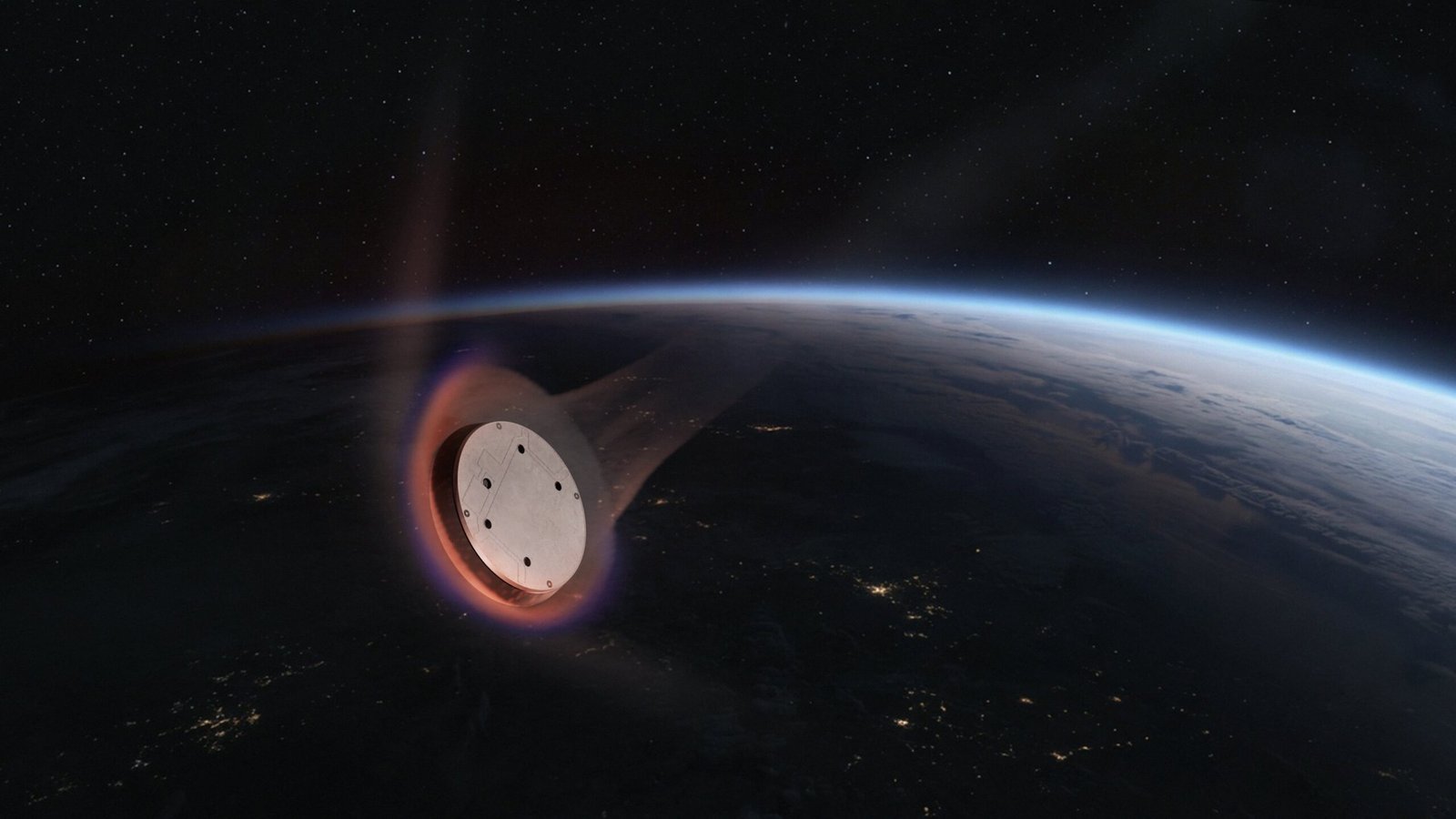
Unveiled through FAA environmental assessments and demonstrated on its maiden flight on June 23, 2026, Starfall is a low-profile cylindrical disk designed for routine return of up to 1,000 kg of high-value payload. Unlike traditional conical capsules, its flat geometry maximizes structural efficiency and payload volume while minimizing ballistic coefficient for controlled reentry.
Physical and Structural Design
Starfall measures 3.1 meters in diameter and only 0.75 meters in height, giving it a classic “hockey puck” profile. Empty mass is approximately 2,100 kg, with capacity for 1,000 kg payload in an internal volume of roughly 2.5 × 1.5 × 0.5 meters. The vehicle splits into two primary modules: a 1,400 kg aluminum top plate (partially wrapped in thermal protection) and a 700 kg carbon-fiber heat shield containing nitrogen COPVs for cold-gas thrusters.
Key Design Advantages of the Disk Configuration
The wide, shallow form factor offers high stability during atmospheric entry, reduced heating rates on the broad face, and straightforward integration with Starship or Falcon 9 payload dispensers. The two-part construction allows the heat shield to jettison after peak heating, exposing parachute attachment points on the top plate for a clean splashdown.
Reentry and Recovery Systems
Lacking a main propulsion system for deorbit, Starfall relies on its host vehicle or an external kick stage for initial trajectory adjustment. Cold-gas nitrogen thrusters provide attitude control during the critical reentry phase. After surviving hypersonic heating, the heat shield separates, deploying a drogue, pilot, and single main parachute for ocean splashdown in the Pacific. Both the top plate and heat shield are designed for recovery and potential reuse.
| Parameter | Starfall Specification | Comparison to Traditional Capsules |
|---|---|---|
| Diameter / Height | 3.1 m / 0.75 m | Much flatter profile than Dragon or Orion |
| Empty Mass | 2,100 kg | Lightweight for its payload class |
| Payload Capacity | Up to 1,000 kg | Competitive with emerging commercial return vehicles |
| Propulsion | Cold-gas N₂ thrusters only | No deorbit burn – relies on host vehicle |
| Landing | Parachute + splashdown | Simple, recoverable, low-cost |
Enabling the In-Space Manufacturing Market
Starfall’s economics are built around high cadence and low unit cost. By using proven materials and eliminating complex reusable propulsion or landing legs, SpaceX aims for rapid production scaling. This creates a viable loop: launch raw materials or experiments on Starship/Falcon 9, process in microgravity (on Starship, dedicated platforms, or future commercial stations), then return finished products quickly and affordably.
The design also supports point-to-point logistics applications, where rapid global delivery of time-sensitive cargo from orbit could become feasible at scale.
Future Horizons and Competitive Positioning
As the first of multiple planned demonstrations, Starfall positions SpaceX not only as a launch provider but as a full-stack participant in the orbital economy. Its simplicity and focus on downmass could accelerate the shift from ISS-style government research to commercially viable microgravity production at unprecedented scale.
Frequently Asked Questions
What is the shape and size of the Starfall capsule?
It is a disk-shaped (cylindrical) vehicle 3.1 meters in diameter and 0.75 meters tall, resembling a large hockey puck.
How much payload can Starfall return?
Up to 1,000 kg in an internal volume of approximately 2.5 × 1.5 × 0.5 meters.
Does Starfall have its own deorbit engine?
No. It uses cold-gas nitrogen thrusters for attitude control only and relies on the launch vehicle or external stage for deorbit.
What happens during recovery?
The heat shield jettisons after reentry, parachutes deploy from the top plate, and the vehicle performs a parachute-assisted splashdown in the ocean for recovery.
How does Starfall support in-space manufacturing?
It provides a scalable, cost-effective way to return high-value microgravity products (pharma, materials, semiconductors) to Earth, closing the economic loop for commercial orbital production.