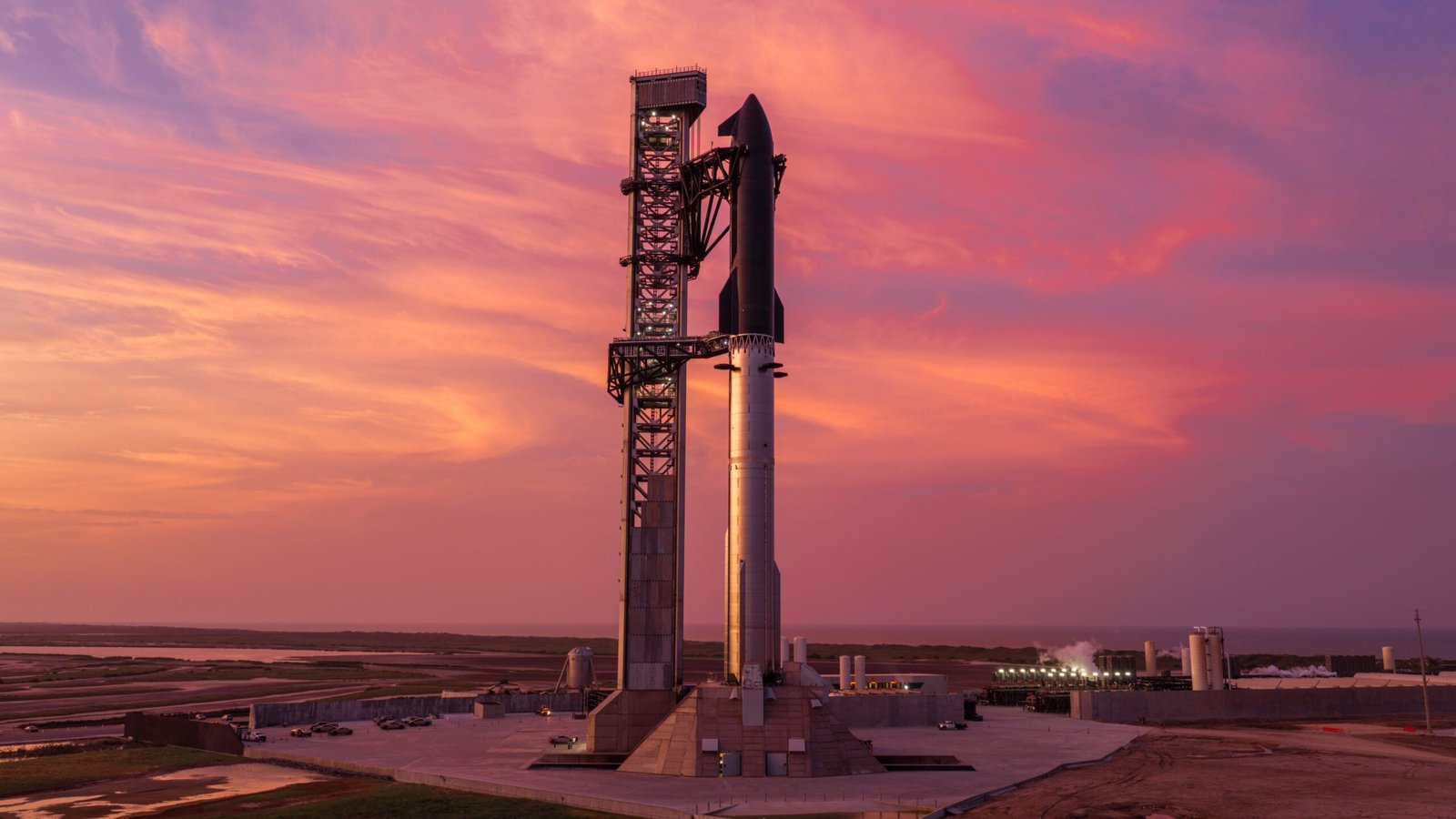

SpaceX Releases Stunning Sunset Photos of Fully Stacked Starship at Starbase Ahead of Critical Flight 13 Launch Attempt
SpaceX Starship Flight 13: Full Mission Profile, Objectives, Vehicles & What to Expect
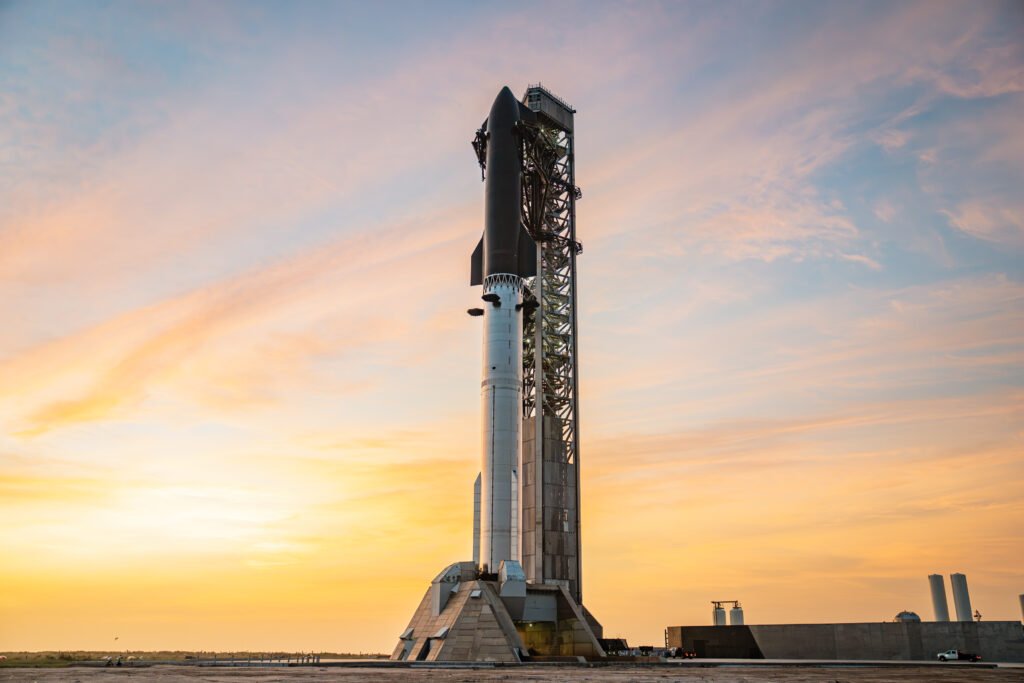
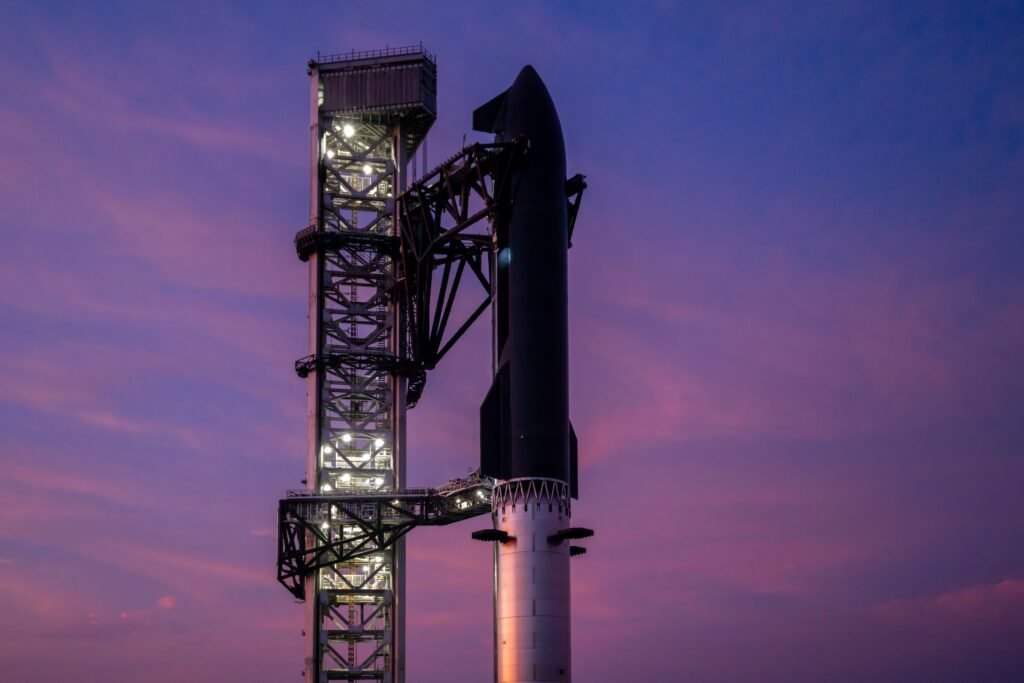
SpaceX has released striking new sunset photos and video of a fully stacked Starship standing tall on Pad 2 at Starbase, capturing the vehicle in golden-hour light just hours before a potential launch attempt. The imagery shows Super Heavy Booster 20 and Ship 40 locked together on the tower, highlighting the scale of the Version 3 (V3) architecture as teams prepare for the thirteenth integrated flight test.
Flight 13 is currently targeting a 90-minute launch window opening at 5:45 p.m. CT (6:45 p.m. EDT / 22:45 UTC) on Thursday, July 23. A live webcast is expected to begin approximately 30 minutes prior. The schedule remains dynamic following a last-second abort on July 16 caused by multiple Super Heavy engines failing to ignite properly. Hardware modifications and additional testing have since been completed.
This flight marks the second outing for the upgraded Starship and Super Heavy V3 vehicles and the first time Starship will carry operational next-generation Starlink satellites.
Vehicles
- Booster: Super Heavy Booster 20 (B20) — 33 Raptor engines
- Ship: Starship Ship 40 (S40) — 3 sea-level Raptors + 3 vacuum-optimized Raptors
- Configuration: Starship-Super Heavy V3 (Block 3)
- Launch Site: Pad 2, Starbase, Boca Chica, Texas
Both vehicles incorporate lessons from Flight 12 (May 22, 2026), which debuted the V3 design but encountered engine-out and boostback issues.
Primary Mission Objectives
Super Heavy Booster
- Successful liftoff, ascent, and hot-staging separation
- Precise directional flip after separation
- Complete boostback burn
- Landing burn and controlled soft splashdown at an offshore point in the Gulf of Mexico
Starship Upper Stage
- Reach planned suborbital trajectory
- Deploy 20 Starlink V3 satellites
- Relight a single Raptor engine in space
- Controlled atmospheric entry, descent, and splashdown in the Indian Ocean
- Collect heat-shield performance data under higher dynamic pressure
Detailed Flight Profile (Approximate Timeline)
All times relative to liftoff (T+0):
| Time | Event |
|---|---|
| T+0:00 | Liftoff |
| T+0:58 | Max Q |
| T+2:18 | Super Heavy Main Engine Cutoff (MECO) |
| T+2:21 | Hot-staging / Stage separation |
| T+2:25–3:03 | Booster boostback burn |
| T+6:27–6:53 | Booster landing burn & splashdown (Gulf) |
| T+8:05 | Starship engine cutoff |
| T+16:40–27:39 | Payload deployment demonstration |
| T+38:58 | Single Raptor in-space relight demo |
| T+47:30 | Starship atmospheric entry interface |
| T+1:02:23 | Transonic |
| T+1:03:01 | Subsonic |
| T+1:05:01–1:05:21 | Landing burn sequence, flip, and splashdown (Indian Ocean) |
The trajectory remains suborbital. The Starlink satellites will be released on a path that results in atmospheric reentry and demise roughly 20 minutes after deployment. Six of the 20 satellites carry specialized camera suites to inspect Ship 40’s heat shield in flight (similar to the Space Shuttle’s RPM inspection) and transmit imagery. Several heat-shield tiles have been painted white to simulate missing tiles as imaging targets. Additional experiments include modified tile attachments on the aft flaps and skirt, plus load-sensing tiles designed to gather data under the higher dynamic pressures enabled by V3 performance.
Improvements from Flight 12
SpaceX implemented targeted hardware and software changes:
- More robust engine startup sequencing on the ship to ensure proper booster flip orientation after hot-staging.
- Hardware upgrades and updated engine alarms/abort logic on the booster to improve multi-engine relight reliability during boostback.
- Propulsion system modifications on the ship to address the engine-out event that occurred ~40 seconds after separation on Flight 12.
- Heat-shield attachment and instrumentation upgrades to support higher ascent loads and future rapid reusability.
Payload Significance
This is the first time Starship will fly real Starlink V3 satellites. The V3 generation is designed to deliver substantially higher capacity and faster speeds. During the short suborbital flight, the satellites will attempt to deploy solar arrays and antennas and establish laser links with the existing constellation and ground stations (including sites in South Africa). Although the satellites will not remain in orbit, the demonstration validates deployment mechanisms and early operations for future full orbital missions.
Why Flight 13 Matters
Flight 13 is a critical step in the iterative development of a fully and rapidly reusable transportation system. Success would further validate V3 performance, demonstrate satellite deployment capability, prove improved engine reliability, and gather essential reentry data needed for future booster and ship catch attempts. These milestones support SpaceX’s longer-term goals of high-cadence Starlink launches, NASA Artemis Human Landing System missions, and eventual Mars transportation.
Teams continue monitoring weather and vehicle health. As of the latest SpaceX updates, the fully stacked vehicle remains on the pad under clear skies following the dramatic sunset photography shared earlier today.
For the most current status, follow the official SpaceX mission page and @SpaceX on X. A successful Flight 13 would represent another major data point on the path toward making life multiplanetary.
Live coverage expected via spacex.com and X beginning ~30 minutes before the opening of the launch window.
Starship Flight 13 FAQ: Everything You Need to Know About SpaceX’s Next Launch
When is the Starship Flight 13 launch date and time?
SpaceX is targeting Thursday, July 23, 2026, with the 90-minute launch window opening at 5:45 p.m. CT (6:45 p.m. EDT / 22:45 UTC) from Pad 2 at Starbase, Texas. A live webcast will start about 30 minutes before liftoff. The schedule is dynamic—check SpaceX’s official site or X account for real-time updates.
What caused the previous Starship Flight 13 scrub?
The July 16 attempt was aborted seconds after booster engine startup when four Raptor engines on Super Heavy failed to ignite properly. SpaceX swapped engines and completed additional testing. Teams are now ready for today’s window.
Which vehicles are flying on Starship Flight 13?
- Booster: Super Heavy Booster 20 (B20) with 33 Raptor engines
- Ship: Starship Ship 40 (S40) with 6 Raptors (3 sea-level + 3 vacuum)
This is the second flight of the upgraded V3 (Block 3) configuration.
What is the mission profile for Starship Flight 13?
It is a suborbital test flight. Key events include liftoff, hot-staging separation, booster boostback and splashdown in the Gulf of Mexico, Starship reaching suborbital trajectory, deployment of satellites, in-space Raptor relight, and controlled splashdown in the Indian Ocean. The full profile builds on Flight 12 with targeted improvements.
What payloads is Starship carrying on Flight 13?
For the first time, Starship will deploy 20 next-generation Starlink V3 satellites. Six have cameras to inspect the heat shield. The satellites will test deployment, arrays, antennas, and laser links before reentering the atmosphere ~20 minutes later.
What are the main objectives of Flight 13?
- Booster: Successful ascent, separation, boostback burn, and soft splashdown.
- Ship: Satellite deployment, in-space engine relight, controlled reentry/descent, and heat-shield data collection under higher stress.
- Overall: Validate V3 hardware fixes and gather data for future reusability and orbital missions.
Why did SpaceX share sunset photos of the fully stacked Starship?
The dramatic sunset images and video highlight the fully stacked vehicle on the tower ahead of launch. They showcase the rocket’s scale and Starbase’s scenic location, generating excitement while providing fans a close look at engineering progress.
What improvements were made since Starship Flight 12?
- More reliable engine startup sequencing for proper booster flip
- Hardware and software upgrades for booster relight reliability
- Propulsion fixes on Ship to reduce engine-out risk
- New heat-shield tile designs, attachments, load sensors, and camera-equipped satellites for inspection
Will the booster or ship be caught on this flight?
No. Flight 13 focuses on controlled splashdowns in the ocean. Tower catch attempts are planned for future flights once data confidence is higher.
How can I watch Starship Flight 13 live?
Watch the official webcast on spacex.com or @SpaceX on X. Third-party streams (e.g., NASASpaceflight) often provide additional camera angles and commentary.
What does success on Flight 13 mean for the Starship program?
It would confirm V3 reliability, prove real satellite deployment capability, advance heat-shield technology, and move SpaceX closer to rapid reusability for Starlink, Artemis lunar missions, and Mars goals.
Where can I see more Starship sunset and launch photos?
Check SpaceX’s official X account for the latest images and video. High-resolution shots of the fully stacked vehicle against the sunset are already circulating widely.