
Introduction
Recovering a rocket booster has become one of the defining engineering challenges of modern spaceflight. For decades, launch vehicles were designed to complete a single mission before falling back to Earth or into the ocean, where they became expensive debris. The emergence of reusable rockets transformed this philosophy, dramatically lowering launch costs while increasing launch frequency.
SpaceX demonstrated that vertical propulsive landing was not only possible but commercially viable. Blue Origin followed with reusable boosters of its own. Now China is pursuing an entirely different path—one that combines controlled descent with a massive offshore recovery platform equipped with an enormous wire-net capture system.
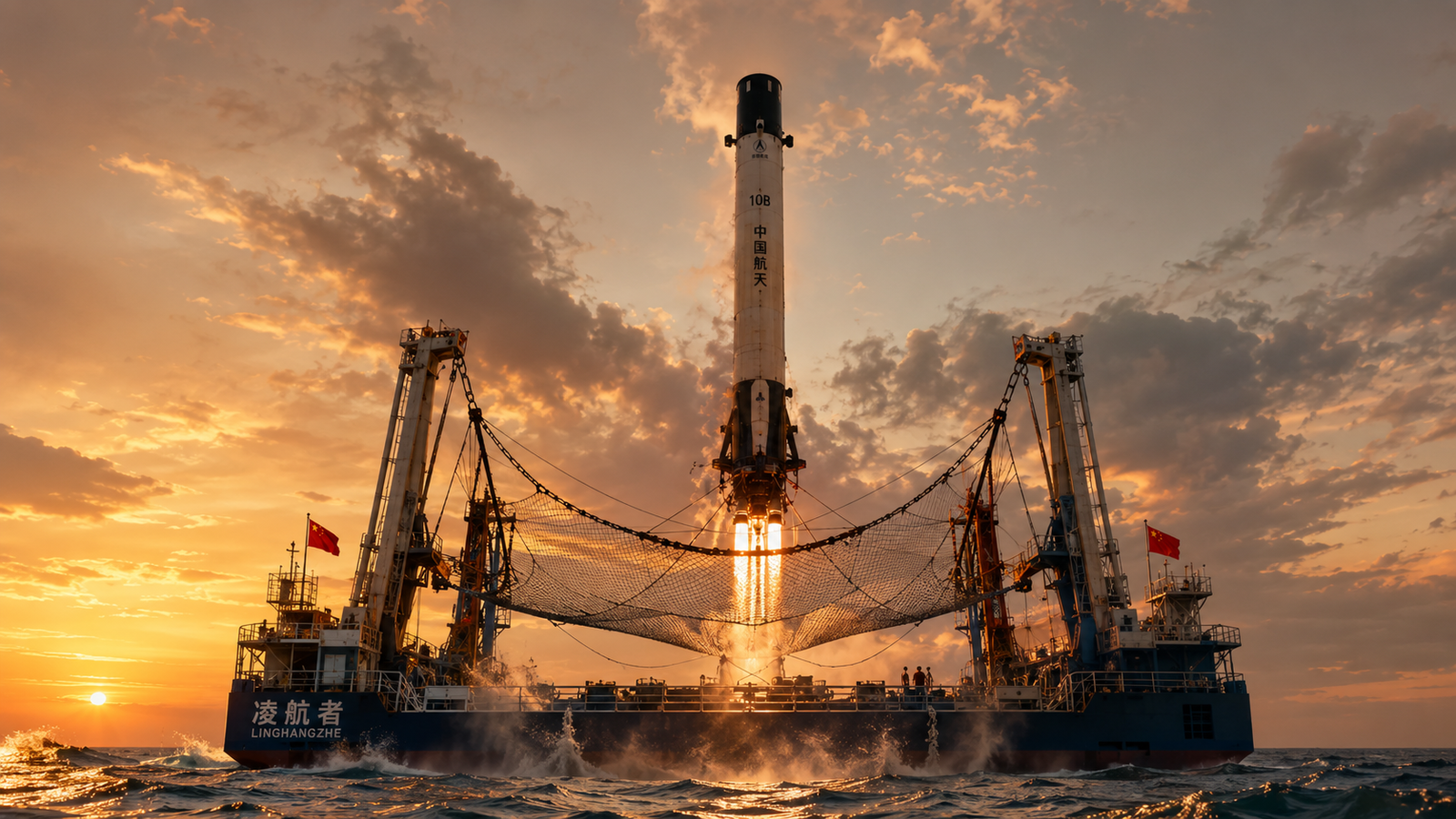
Instead of landing directly on a floating platform using landing legs, Chinese engineers are testing a concept in which a descending rocket booster is caught inside a giant tensioned steel net suspended above the ocean. The approach aims to simplify booster design, reduce landing mass, and improve recovery reliability under certain operating conditions.
Although still under development, this concept represents one of the most unusual recovery methods ever proposed for orbital-class rockets.
Why Recovering Rocket Boosters Matters
A modern first-stage booster represents the majority of a launch vehicle’s manufacturing cost. Depending on the rocket, the first stage can account for roughly 60–80% of total vehicle cost because it contains:
- Propellant tanks
- High-performance engines
- Avionics
- Guidance systems
- Structural components
- Pressurization systems
Throwing away these components after every launch is economically inefficient.
Recovering and reusing boosters offers several advantages:
| Benefit | Explanation |
|---|---|
| Lower launch cost | Expensive engines can fly multiple missions. |
| Higher launch cadence | Less manufacturing is required between launches. |
| Faster production | Existing hardware returns to service. |
| Better sustainability | Less aerospace waste is generated. |
| Increased competitiveness | Launch providers can offer lower prices. |
China’s rapidly expanding launch market makes reusable systems increasingly important.
China’s Growing Reusable Rocket Program
China has accelerated reusable launch vehicle development over the past few years.
Both government organizations and commercial launch companies—including LandSpace, Space Pioneer, iSpace, and Deep Blue Aerospace—are developing reusable rockets.
Many of these vehicles resemble SpaceX’s Falcon 9 architecture:
- Vertical launch
- Liquid methane engines
- Grid fins
- Controlled descent
- Engine relight
- Precision landing
However, several Chinese programs are exploring recovery methods that differ significantly from Falcon 9.
One of the most ambitious involves recovering a booster at sea using a giant suspended wire net.
The Challenge of Landing a 70-Meter Booster
A rocket standing approximately 70 meters tall presents extraordinary recovery challenges.
Even after burning nearly all of its propellant, the booster still weighs tens of tonnes.
During descent it must:
- survive atmospheric heating
- maintain stability
- control roll, pitch, and yaw
- restart engines
- compensate for ocean winds
- account for moving recovery platforms
- avoid structural oscillations
A small landing error of only a few meters can result in:
- engine damage
- structural collapse
- tipping over
- explosion
- loss of vehicle
Traditional landing legs add weight while requiring complex deployment mechanisms.
China’s wire-net concept attempts to eliminate much of this complexity.
What Is the Wire-Net Recovery System?
Imagine a giant steel net suspended between multiple towering support structures mounted on a large offshore platform.
The net functions like an enormous energy absorber.
Instead of touching down directly onto a deck, the descending booster enters the center of the net while still under controlled propulsion.
As the vehicle settles into the net, the structure flexes and distributes impact forces across hundreds of steel cables.
Rather than relying on rigid contact with a landing pad, the system gradually absorbs kinetic energy.
The idea is surprisingly similar to systems used for:
- aircraft arresting cables
- helicopter recovery systems
- industrial impact absorbers
- safety catch nets
However, the scale is unprecedented.
The net must safely capture a vehicle weighing tens of tonnes while maintaining structural integrity.
How the Recovery Sequence Works
The complete recovery operation may occur in several stages.
Stage 1: Reentry
After stage separation, the booster performs a controlled reentry burn to reduce speed and heating.
Grid fins provide aerodynamic steering throughout descent.
Stage 2: Guidance
Using GPS, inertial navigation systems, radar, and onboard computers, the booster continuously calculates its position relative to the recovery vessel.
Autonomous flight software adjusts engine thrust several times per second.
Stage 3: Landing Burn
Near the ocean platform, one or more engines ignite again.
This dramatically reduces descent velocity.
Instead of reaching zero velocity at touchdown, engineers may intentionally maintain a small controlled downward speed.
Stage 4: Net Capture
The booster enters the center opening.
Steel cables deform elastically while hydraulic dampers dissipate remaining energy.
The booster becomes suspended rather than standing freely.
Stage 5: Securing
Robotic equipment or cranes stabilize the vehicle.
The booster is then lowered onto transport equipment for inspection.
Engineering Behind the Wire Net
Designing such a system involves numerous engineering disciplines.
High-Strength Steel Cables
The cables must withstand enormous tensile loads.
Possible materials include:
- high-carbon steel
- alloy steel
- ultra-high-strength cable systems
Each cable shares only part of the total load.
Energy Absorption
Instead of stopping the booster instantly, the net stretches slightly.
This increases stopping distance.
According to Newton’s Second Law,
Force = Mass × Deceleration
Increasing stopping distance reduces peak deceleration forces.
The principle is identical to:
- car crumple zones
- climbing ropes
- arresting systems on aircraft carriers
Hydraulic Dampers
Hydraulic cylinders may absorb additional kinetic energy.
These convert motion into heat through controlled fluid flow.
This prevents violent rebound.
Distributed Load Paths
Rather than concentrating force at one point, hundreds of cable intersections distribute loads throughout the structure.
This greatly reduces local stress concentrations.
Why Not Simply Land Like Falcon 9?
SpaceX’s Falcon 9 lands vertically using four deployable landing legs.
That system has proven extremely successful.
However, landing legs introduce several engineering penalties.
| Landing Legs | Wire-Net Capture |
|---|---|
| Adds structural mass | Reduces onboard landing hardware |
| Complex deployment | No leg deployment required |
| Requires perfectly flat surface | Net tolerates small alignment errors |
| Hard touchdown risks damage | Energy absorbed gradually |
| Booster stands independently | Booster remains suspended initially |
Removing landing legs could improve payload capacity because every kilogram saved on the booster can potentially increase payload to orbit.
Technical Challenges
Despite its promise, the wire-net concept faces significant obstacles.
Precision Guidance
The booster must enter the net with extraordinary accuracy.
An error of only a few meters could cause collision with support towers.
Ocean Motion
Unlike land pads, offshore platforms move continuously.
They experience:
- roll
- pitch
- heave
- yaw
Real-time compensation is essential.
Crosswinds
Strong winds may push the booster sideways during the final seconds.
The guidance system must compensate almost instantly.
Structural Oscillation
A captured booster could swing inside the net.
Engineers must prevent dangerous oscillations.
Dynamic Loads
Unlike static loads, impact forces change rapidly.
Computer simulations involving finite element analysis are required to predict cable behavior.
Advantages of Offshore Recovery
Recovering boosters at sea offers several strategic benefits.
| Advantage | Reason |
|---|---|
| Improved safety | Away from populated areas |
| Flexible positioning | Ships can relocate based on launch trajectory |
| Reduced overflight risk | Debris falls over ocean if failure occurs |
| Easier logistics | Recovery near splash zone |
| Supports larger rockets | Less constrained than fixed land sites |
This flexibility becomes increasingly valuable as launch cadence increases.
Comparison with Other Recovery Methods
| Method | Example | Advantages | Disadvantages |
|---|---|---|---|
| Ocean splashdown | Early Falcon 9 | Simple | Severe saltwater damage |
| Parachute recovery | Rocket Lab Electron fairings | Lightweight | Weather dependent |
| Vertical landing | Falcon 9 | Proven reusable system | Heavy landing hardware |
| Mid-air helicopter capture | Experimental | Avoids ocean exposure | Extremely difficult |
| Wire-net capture | Chinese concept | Potential weight savings | Still experimental |
Could This Work for Super Heavy?
SpaceX already plans an entirely different recovery system.
Instead of landing on legs, Super Heavy is designed to be caught by giant mechanical arms mounted on the launch tower.
Known informally as “Mechazilla,” this approach eliminates landing legs entirely.
China’s offshore wire-net concept shares one common goal:
Remove unnecessary landing hardware.
However, the implementation differs dramatically.
| Feature | SpaceX Tower Catch | China’s Wire-Net |
|---|---|---|
| Location | Launch tower | Offshore vessel |
| Capture | Mechanical arms | Flexible steel net |
| Landing surface | Tower | Ocean platform |
| Hardware | Tower arms | Cable system |
| Mobility | Fixed | Mobile |
Control Systems Required
Modern reusable boosters rely heavily on software.
A wire-net recovery would likely require:
- GPS corrections
- Inertial Measurement Units
- Radar altimeters
- Laser ranging
- Machine vision
- Real-time wind estimation
- Predictive trajectory models
- Autonomous fault detection
Thousands of sensor readings per second may be processed during the final landing phase.
Artificial intelligence may eventually improve trajectory prediction under changing environmental conditions.
Materials Engineering
The recovery structure itself must survive repeated captures.
Potential design requirements include:
- corrosion-resistant coatings
- fatigue-resistant cable alloys
- modular cable replacement
- marine-grade steel
- vibration damping
- high-load anchor systems
Saltwater corrosion presents one of the greatest long-term maintenance challenges.
Economic Impact
If successful, the wire-net approach could reduce operational costs in several ways.
Potential savings include:
- lighter booster structures
- fewer moving components
- reduced maintenance
- simplified landing mechanisms
- increased payload capacity
However, these savings must offset the significant cost of building and maintaining specialized offshore recovery platforms.
Whether the economics prove favorable will depend on how frequently boosters are recovered and reflown.
Remaining Unknowns
Because the system is still undergoing development, several important questions remain unanswered.
These include:
- Maximum allowable capture velocity
- Net lifespan
- Cable replacement intervals
- Recovery turnaround time
- Performance during rough seas
- Automation level
- Long-term reliability
- Maintenance costs
Only repeated operational use will determine whether the concept can compete with conventional propulsive landings.
The Future of Reusable Launch Systems
The global launch industry is rapidly evolving beyond expendable rockets. Every major spacefaring nation now recognizes that reusability is essential for reducing costs and supporting the growing demand for satellite deployments, lunar missions, and eventually human exploration of Mars.
China’s wire-net recovery system demonstrates that there is no single solution to reusable rocketry. Instead of copying existing designs outright, engineers are exploring alternative methods that may offer unique advantages for specific launch vehicles and operational environments.
Whether the concept ultimately succeeds or not, it contributes valuable engineering knowledge in structural dynamics, autonomous guidance, offshore operations, and large-scale energy absorption systems. Many technologies developed for this system could find applications beyond rocketry, including heavy industrial lifting, marine engineering, and impact mitigation systems.
As reusable launch technology continues to mature, future rockets may use a variety of recovery methods depending on mission requirements. Some may land on towers, others on landing pads, and some may rely on innovative capture systems like tensioned wire nets. The coming decade will likely determine which approaches offer the best balance of cost, reliability, safety, and operational efficiency.
Conclusion
China’s proposed wire-net recovery system represents one of the most unconventional approaches to reusable rocketry. Rather than relying on landing legs or tower-mounted catching arms, the concept uses a massive tensioned steel network to absorb the remaining energy of a descending booster over the ocean. If engineers can solve the demanding challenges of precision guidance, moving platforms, structural dynamics, and marine operations, the system could provide an alternative path toward rapid and economical rocket reuse.
Although the technology remains experimental, it highlights a broader trend in the space industry: innovation is no longer focused solely on reaching orbit, but on returning valuable hardware safely and efficiently. As competition among global launch providers intensifies, creative recovery methods like China’s wire-net system may play an increasingly important role in shaping the future of affordable and sustainable access to space.