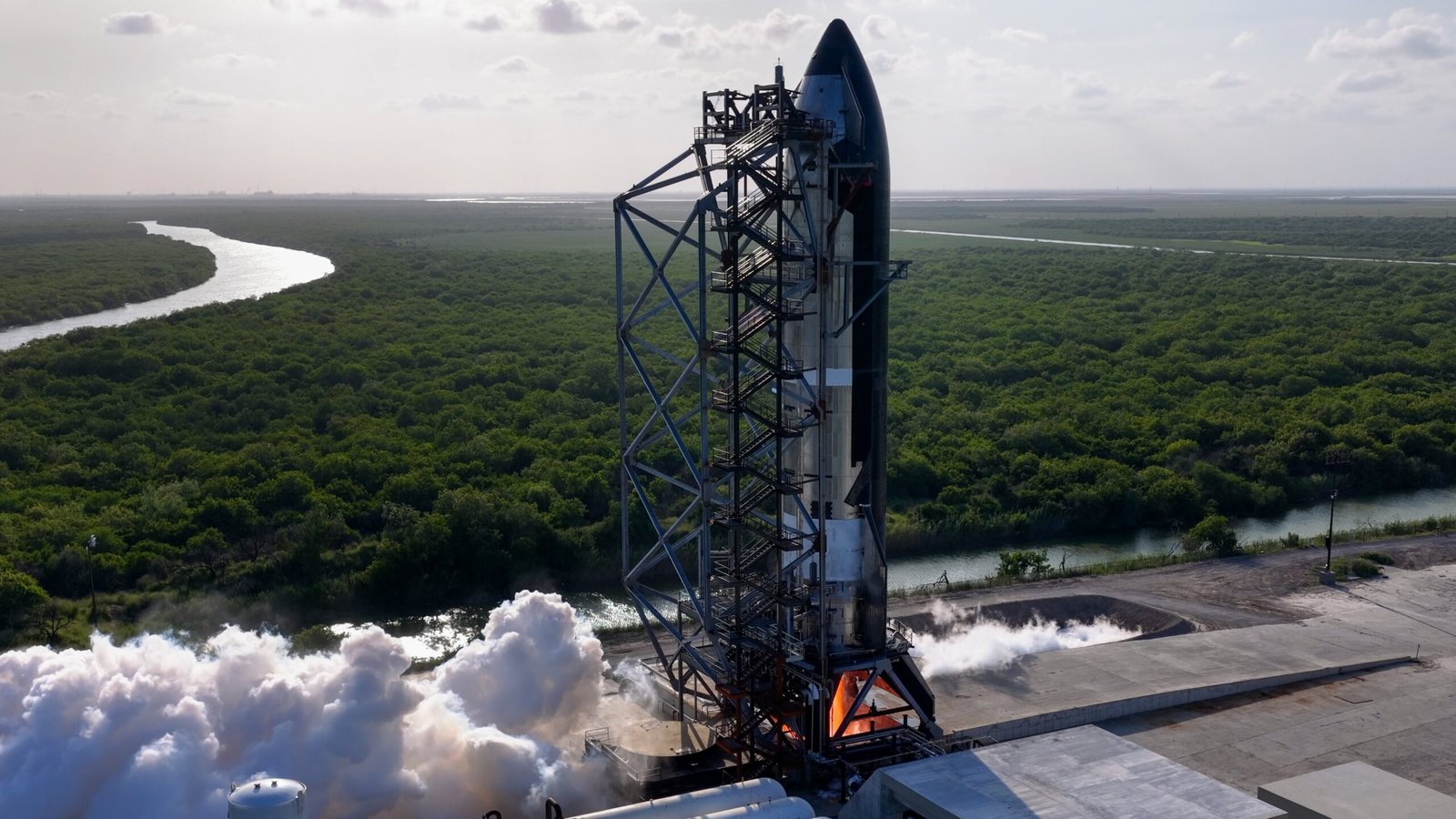

Accelerating the Cadence: Ship 40 Breathes Fire at Starbase
Barely a month after the debut of the Version 3 (V3) Starship architecture on Flight 12, SpaceX has rapidly shifted its industrial momentum toward the upcoming Flight 13 campaign. On June 25, 2026, the program completed a critical milestone at the Massey Outpost test complex in Boca Chica, Texas: a full-duration single-engine static fire of Ship 40, the designated upper stage for the next integrated flight. This rapid turnaround highlights SpaceX’s strategy to treat Starship development as a high-rate manufacturing operation, minimizing the long operational gaps typical of traditional legacy aerospace workflows.
Isolating Performance Data with Single-Engine Burns
During the June 25 qualification run, Ship 40 fired one of its central sea-level Raptor 3 engines for approximately 15 to 17 seconds. While multi-engine static fires capture the headlines, isolated single-engine burns provide engineers with clean, high-fidelity diagnostic data. By firing just one power unit, telemetry teams can meticulously monitor localized fluid dynamics, turbine pressures, and thermal limits without acoustic or vibration interference from adjacent systems. Crucially, the test included a 20-minute hold sequence specifically designed to simulate vacuum-like space environments, confirming the system’s structural and pneumatic baseline behavior under realistic flight constraints.
Validating the Raptor 3 Core and Orbital Reignition Sequences
The Ship 40 upper stage configuration utilizes six next-generation Raptor 3 engines: three sea-level variants and three vacuum-optimized (RVac) variants. While all six fire simultaneously to clear Earth’s upper atmosphere, the landing profile relies entirely on a precise flip maneuver powered by a single sea-level engine. Experts note that this full-duration static fire likely acted as a warm-propellant test, directly validating the engine’s capability to execute an on-orbit reignition sequence. Ensuring that the Raptor 3 can reliably restart after long coast phases is paramount to executing successful, controlled ocean splashdowns or future return-to-launch-site tower catches.
Ship 40 Development Timeline and Testing Milestones
Ship 40 represents the continuation of the Block 3 manufacturing standard, integrating deep structural optimizations. The table below traces the prototype’s rapid progression from structural stacking to its recent live-fire trial:
| Milestone Phase | Completion Date | Test Parameters & Scope | Operational Significance |
|---|---|---|---|
| Full Assembly Stacking | March 2, 2026 | Nosecone-to-aft integration completed in Mega Bay 2 | Establishes structural integrity of the 52-meter upper stage |
| Thermal Tile Installation | April 12, 2026 | Application of refined thermal protection system (TPS) tiles | Secures the leeward and windward shielding for reentry profiles |
| Cryogenic Proof Testing | May 3–4, 2026 | Dual-tank sub-cooled liquid nitrogen pressure loading at Massey’s | Validates structural weld strength and dome pressure thresholds |
| Engine Integration | June 5–6, 2026 | Installation of 3 Sea-Level and 3 Vacuum Raptor 3 engines | Populates the aft bay with high-thrust, streamlined propulsion |
| Single-Engine Static Fire | June 25, 2026 | 17-second single Raptor 3 burn with space-simulated hold | Confirms ignition health and verifies orbital restart dynamics |
Securing the Path to Integrated Flight 13
Following the successful live-fire test, Ship 40 was unmounted and rolled back to Mega Bay 2 on June 26 for routine post-test inspections and final hardware checkouts. This success clears a massive regulatory and technical hurdle on the pre-flight checklist. The next steps in the qualification campaign will step up in intensity, transitioning to a full six-engine integrated static fire of Ship 40 alongside the 33-engine static fire of its paired first-stage booster, Booster 20. Targeted to launch later this summer, Flight 13 will push the boundaries of V3 capabilities, testing upgraded grid fins, increased internal propellant volume, and high-voltage electrically actuated cryogenic recirculation.
Broader Implications for Artemis and Orbital Logistics
Perfecting upper-stage restart reliability extends far beyond simple launch-and-catch demonstrations. Under NASA’s Artemis program, Starship must serve as a dependable Human Landing System (HLS), requiring an extensive orbital logistics chain. Before reaching the Moon, a standard Starship vehicle will need to rendezvous and dock with orbiting propellant tankers via newly integrated leeward docking drogues. Because each propellant transfer demands exact orbital tracking and precise engine cycles, successful standalone burns like the one executed by Ship 40 lay the foundational bricks for automated, deep-space fleet operations.
Frequently Asked Questions
What was the primary objective of Ship 40’s single-engine static fire?
The test isolated individual Raptor 3 behavior under precise, controlled conditions to evaluate ignition reliability, verify telemetry data, and simulate the warm-propellant parameters needed for an orbital engine restart during flight.
Where and when did the Ship 40 engine test take place?
The test occurred on June 25, 2026, at SpaceX’s Massey Outpost test complex, located near the main Starbase facility in Boca Chica, Texas.
How long did the engine burn, and what specific sequence was included?
The single sea-level Raptor 3 engine burned for approximately 15 to 17 seconds. Crucially, the test sequence included a 20-minute hold designed to simulate the harsh, real-world conditions encountered during space flight.
What engine configuration is utilized on the Ship 40 upper stage?
Ship 40 is equipped with six next-generation Raptor 3 engines: three standard sea-level engines for atmospheric ascent and landing maneuvers, and three vacuum-optimized (RVac) engines featuring larger nozzles for high-efficiency operation in space.
What are the next major testing milestones before the Flight 13 launch?
Following its rollback to Mega Bay 2 for inspections, Ship 40 will eventually progress to an integrated six-engine static fire. Concurrently, SpaceX will prepare its paired first-stage partner, Booster 20, for a full 33-engine static fire on the orbital launch mount.