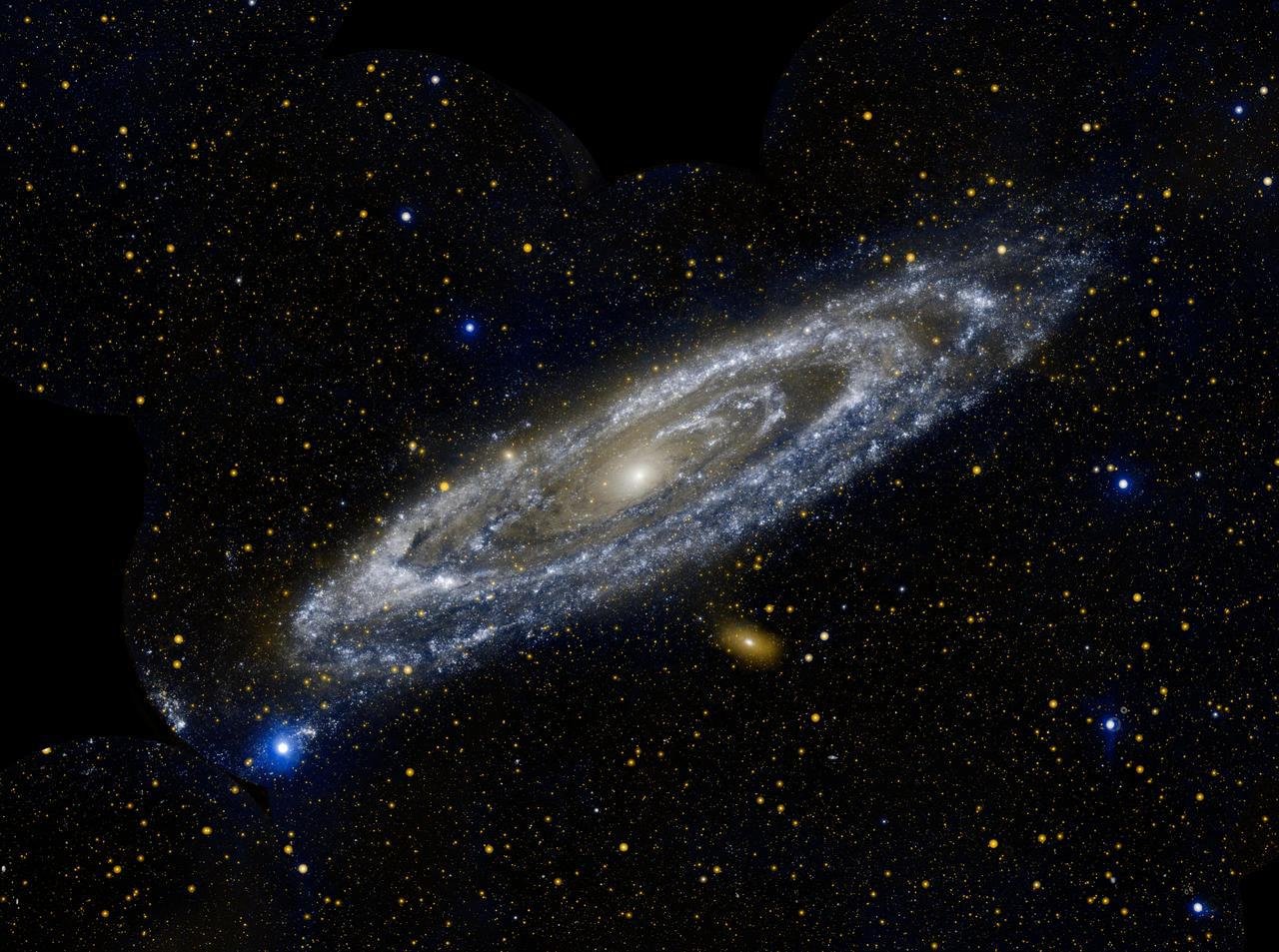

Look up at the night sky. Every star you see is a blazing nuclear furnace producing light and heat. Entire galaxies glow because of trillions of these stars. But what if one day all of them were gone?
No sunlight. No starlight. No galaxies shining in the darkness.
According to modern cosmology, this may be the ultimate fate of our universe.
Scientists call this scenario the Heat Death of the Universe—a future so distant that it stretches the limits of human imagination. It is currently considered one of the leading scientific theories for how the universe could eventually end.
The universe is approximately 13.8 billion years old, but the events described in this article unfold over periods measured in trillions, quadrillions, and even googols of years.
So what would the very last day of the universe actually look like?
Let’s follow the timeline to the end of everything.
The Universe Is Already Moving Toward Its End
The story begins today.
Observations show that the universe is expanding. More importantly, it is expanding at an accelerating rate because of a mysterious phenomenon known as dark energy.
As galaxies drift farther apart, the universe becomes increasingly cold, empty, and isolated.
Scientists estimate that ordinary matter—the atoms making up stars, planets, and people—accounts for only about 5% of the universe’s total energy content.
Composition of the Universe
| Component | Approximate Percentage |
|---|---|
| Dark Energy | 68% |
| Dark Matter | 27% |
| Ordinary Matter | 5% |
The dominance of dark energy means the expansion is expected to continue indefinitely.
If that happens, the universe gradually loses the ability to create new structures and new sources of energy.
The End of Star Formation
The first major milestone arrives in roughly 100 trillion years.
Today, galaxies contain vast clouds of hydrogen gas. These clouds collapse under gravity to form new stars.
But hydrogen is not unlimited.
Eventually galaxies will consume nearly all available star-forming material.
No new stars will be born.
Astronomers call this period the Degenerate Era.
The night sky would already look dramatically different.
Many galaxies would be invisible because cosmic expansion would carry them beyond the observable horizon. Civilizations living in the distant future might see only their local galaxy and nothing else.
The universe would begin to resemble a cosmic ghost town.
When the Last Star Dies
After trillions of years, even the longest-lived stars exhaust their nuclear fuel.
Red dwarfs—the smallest and most efficient stars known—can survive for up to 10 trillion years.
But even they eventually go dark.
The death of the final star marks one of the most important moments in cosmic history.
For the first time since stars began forming, the universe would have no significant natural source of visible light.
Imagine standing on a planet under a sky containing no stars at all.
Only darkness.
No sunrise.
No galaxies.
No bright points in the heavens.
This is the beginning of the cosmic night.
The Age of Stellar Corpses
After the stars disappear, their remnants remain.
These include:
- White dwarfs
- Neutron stars
- Black holes
- Brown dwarfs
These objects contain enormous amounts of mass but produce little or no light.
Over unimaginable periods of time, gravitational interactions slowly eject many of them from galaxies.
Galaxies themselves begin to disintegrate.
Stars that once orbited peacefully around galactic centers are flung into intergalactic space.
The universe becomes increasingly empty.
What Happens to Earth?
Long before the universe reaches this stage, Earth will be gone.
The Sun is expected to exhaust its hydrogen fuel in roughly 5 billion years.
As it expands into a red giant, it may engulf Mercury, Venus, and possibly Earth.
Even if Earth survives physically, its oceans will have evaporated billions of years earlier.
Humanity’s long-term survival would require becoming a multi-planetary and eventually multi-star civilization.
Ironically, even that may only delay the inevitable.
The universe itself is running down.
Black Holes Become the Kings of the Cosmos
As stars disappear, black holes dominate the universe.
Supermassive black holes already exist at the centers of most galaxies.
Some contain billions of times the mass of the Sun.
For a long period, black holes become the largest surviving structures in existence.
Yet even they are not immortal.
In 1974, physicist Stephen Hawking demonstrated that black holes slowly emit radiation.
This process is known as Hawking Radiation.
The larger the black hole, the slower it evaporates.
A supermassive black hole could survive for approximately:
Estimated Lifetimes
| Object | Approximate Lifetime |
|---|---|
| Sun | 10 Billion Years |
| Red Dwarf Star | 10 Trillion Years |
| White Dwarf | Quadrillions of Years |
| Supermassive Black Hole | Up to 10¹⁰⁰ Years |
That final number is almost impossible to comprehend.
It is a 1 followed by 100 zeros.
Yet even these cosmic giants eventually disappear.
The Last Black Hole Evaporates
Far beyond any recognizable era of cosmic history comes a dramatic event.
The evaporation of the final black hole.
This may be the closest thing the universe has to a “last fireworks show.”
As black holes shrink, they emit increasing amounts of radiation.
The final moments could release a burst of energy before the black hole vanishes completely.
When the last black hole evaporates, the universe loses its final major structure.
Nothing comparable remains.
No stars.
No planets.
No galaxies.
No black holes.
Only elementary particles drifting through nearly empty space.
The Approach of Heat Death
At this stage, the universe enters what physicists call maximum entropy.
Entropy is often described as a measure of disorder.
A low-entropy system contains usable energy.
A high-entropy system does not.
The universe naturally evolves toward higher entropy.
This process drives everything from melting ice cubes to burning stars.
Heat Death occurs when entropy reaches its maximum possible value.
At that point:
- No energy gradients exist.
- No useful work can be performed.
- No stars can ignite.
- No complex structures can form.
The cosmos becomes a nearly uniform sea of particles and extremely low-energy radiation.
What Would the Last Day Actually Look Like?
Surprisingly, there may not be a dramatic explosion.
No final countdown.
No cosmic collapse.
No giant flash visible across the universe.
Instead, the end arrives slowly.
The last day of the universe might be indistinguishable from the day before it.
A hypothetical observer would see:
- Infinite darkness
- No visible stars
- No galaxies
- No planets
- No black holes
- Extremely cold temperatures
- Sparse particles separated by enormous distances
The temperature of space would approach absolute zero.
The universe would be silent and motionless on any meaningful scale.
Time would continue, but nothing significant would happen.
The cosmic story would simply fade away.
Could Anything Survive?
This remains one of the biggest questions in theoretical physics.
Some researchers have proposed that extremely advanced civilizations might find ways to survive far longer than stars themselves.
Ideas include:
- Harvesting black hole energy
- Utilizing quantum processes
- Creating artificial habitats around stellar remnants
- Generating entirely new universes
However, every currently known strategy eventually confronts the same problem:
Entropy.
If the laws of physics remain unchanged, Heat Death appears unavoidable.
Alternative Endings for the Universe
Heat Death is not the only possibility.
Scientists have proposed several competing scenarios.
| Theory | Description |
|---|---|
| Heat Death | Universe expands forever and becomes cold and empty |
| Big Rip | Expansion accelerates until galaxies, stars, planets, and atoms are torn apart |
| Big Crunch | Expansion reverses and the universe collapses inward |
| Vacuum Decay | A quantum event suddenly destroys the current universe |
Current observations suggest Heat Death remains one of the most plausible outcomes, although future discoveries could change our understanding.
Why This Matters Today
The Heat Death of the Universe will not happen tomorrow.
It will not happen next year.
It will not happen while humanity exists on Earth.
Yet studying the ultimate fate of the cosmos reveals something profound.
The stars above us are temporary.
Galaxies are temporary.
Even black holes are temporary.
The universe itself may be temporary.
Everything we know exists during a brief chapter of an incredibly long cosmic story.
And despite the unimaginable scales involved, we are fortunate enough to live during the era when stars still shine, galaxies still glow, and the universe is filled with light.
One day that light may disappear forever.
When it does, the last day of the universe will not arrive with a bang.
It will arrive with silence, darkness, and a slow fade into eternity.